
Ward County Projected Versus Actual Release
A projected release date is a calculation, not a promise. For a TDCJ prisoner, it is the Classification and Records estimate of when incarceration may end if parole does not occur sooner. A later Scheduled Release date and Scheduled Release location appear only after the release certificate has been audited and operational arrangements advance. The actual release date is the historical confirmation that custody ended.
Other future dates answer different questions. A parole eligibility date is the first point at which review can lead toward parole under the governing rules. A maximum sentence date marks another sentence endpoint. Neither proves that a person walked out. A Board denial, a release-plan issue, a hold, a program requirement, or a corrected record may change the path.
- Projected release date
- TDCJ's current calculation if parole does not occur sooner.
- Scheduled release
- A later operational date after audit and release processing.
- Parole eligibility
- The point when parole consideration may occur, not a release date.
- Actual release
- The dated historical event confirming custody ended.
- Detainer
- A request or legal basis for another agency to take or retain custody.
Find Ward County Projected Dates
The correct method follows the sentence. TDCJ does not calculate the release date for a person held only on a Ward County pretrial matter or serving a purely local sentence. Likewise, the Ward County Sheriff cannot replace TDCJ Classification and Records for a state-prison projection. First determine whether the jail entry ended in community release, county confinement, or transfer to state custody.
- Check the case and custody system. A Ward jail “transfer” to TDCJ is continued incarceration, not release.
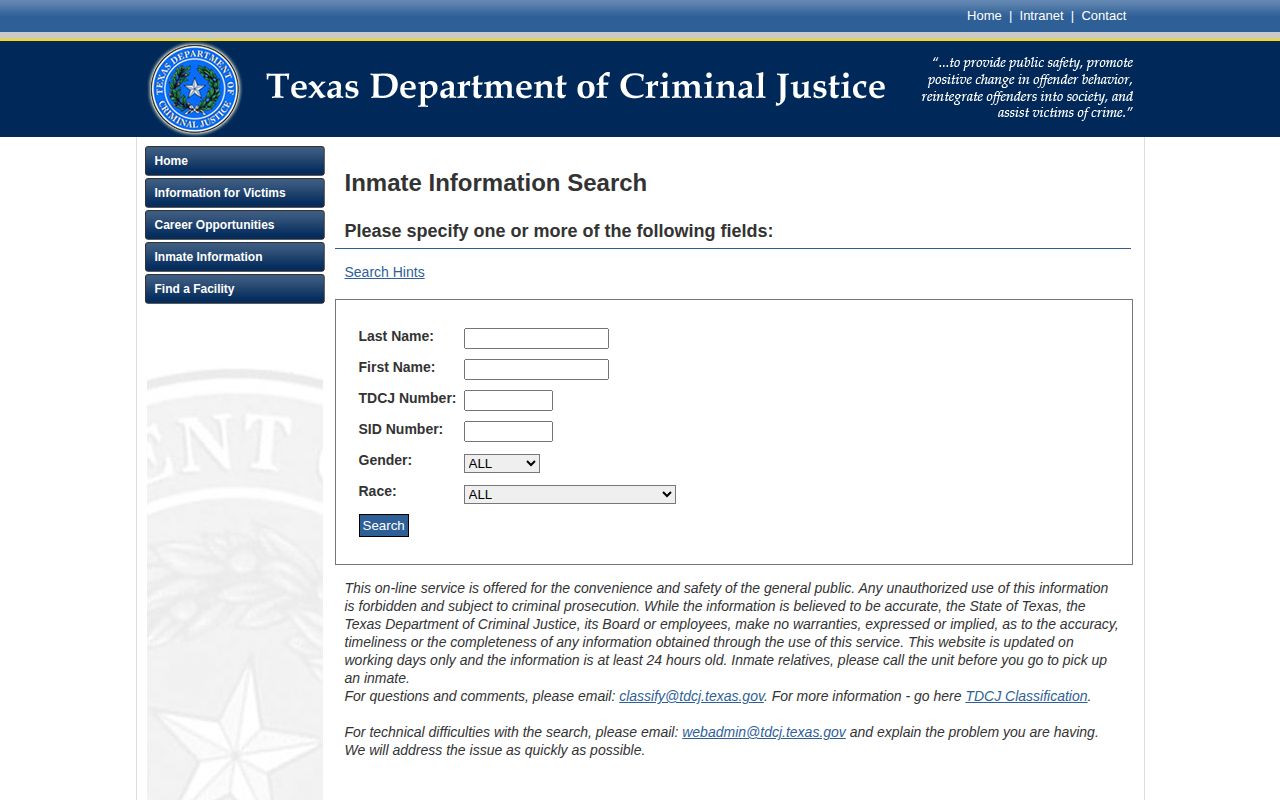
- For state custody, open the TDCJ Inmate Information Search.
- Search by the seven-digit TDCJ number or SID number when known. Otherwise use last and first name and compare available identifiers.
- Open the correct detail and read Projected Release Date, Parole Eligibility Date, Maximum Sentence Date, location, and status together.
- For a county sentence, obtain the judgment, jail-credit determination, and sheriff's calculation from the Ward court and jail records.
- For pretrial custody, check bond and later court orders, then ask the jail whether custody continues. Do not expect a fixed projection.
- Save the displayed date and lookup date. Confirm again near the event and after actual release.
The Ward County released-inmate records route distinguishes a community exit from a transfer. When an older or absent TDCJ record cannot be resolved online, use the official offender-information alternatives. TDCJ accepts an email inquiry with a full name and TDCJ number, or exact birth date, approximate age, and county of conviction when the number is unknown.
The official TDCJ search shows the fields used for a Texas state-prison release-date lookup.
Ward County Jail Has No Fixed Date
A pretrial detainee at the Ward County jail often has no scheduled release day. Release can depend on posting bond, a personal bond, dismissal, a court order, transfer, or a later judgment. The court document may authorize release, but it does not prove the exact hour when the jail finishes identity checks, paperwork, property return, and any hold review.
For a county-jail sentence, request the judgment, credited time, and the sheriff's calculation. TDCJ's statewide projection does not control a sentence served only in county custody. Ask the Ward County Sheriff whether custody continues and whether another agency has a detainer. If custody ended, request the release date and time, release authority or type, and destination or receiving agency.
Can bond provide the exact release time? No. A bond or release order creates a legal route, but the dated jail record confirms physical processing.
Texas Good Time and Ward Releases
Texas good-conduct time does not simply erase days from the judicial sentence. Government Code §498.003 says good time affects eligibility for parole or mandatory supervision and does not otherwise reduce sentence length. Classification, participation, forfeiture, and restoration matter. Section 498.004 addresses loss and restoration of credits.
Under the general parole formula in Government Code §508.145(f), calendar time plus good time must equal one-fourth of the sentence or fifteen years, whichever is less. The serious-offense rule in subsection (d) generally requires one-half of the sentence or thirty calendar years, whichever is less, without good time counting toward that threshold. The statute also contains a calendar-time minimum and offense-specific provisions. Capital and other categories have separate rules.
Texas therefore has no universal “serve 85 percent” requirement. The offense, offense date, sentence, consecutive terms, and applicable subsection control. Good time may move eligibility without guaranteeing Board approval or the physical release date. A credit calculation must come from the responsible records authority, not from informal arithmetic based only on sentence length.
Note: Eligibility permits consideration; it does not compel the Board to approve release.
What Changes Ward Release Dates
A displayed projection reflects the record as it stands at the time of the search. Later decisions and corrections can move it. Some factors change credit or eligibility. Others delay physical release even when the calculation itself looks stable.
| Factor | Possible effect | Where to verify |
|---|---|---|
| Parole approval or denial | Approval may lead to an earlier route; denial or deferral can leave a later projection | Board and TDCJ parole status |
| Program completion | A required program can delay release processing | TDCJ status and release guidance |
| Release-plan approval | An incomplete plan can prevent scheduling | TDCJ Parole Division |
| Detainer, warrant, or court order | May hold the person or transfer custody | TDCJ, court, and receiving agency |
| Disciplinary credit action | Forfeiture or restoration can alter eligibility calculations | TDCJ Classification and Records |
| Consecutive sentences | Changes how terms combine | Judgment and TDCJ record |
| Record correction | May move any future date | Originating court and records office |
Mandatory supervision is not automatic for every person. Government Code §508.149 excludes listed offenses and classes. It also permits a panel to deny qualifying post-1996 cases under statutory findings. A denial can move a displayed projection toward maximum expiration, while later approval may move it earlier. Section 508.147 governs release to mandatory supervision, and §508.154 addresses the certificate.
Ward County Parole Eligibility Dates
Texas Board review adds another layer between eligibility and release. Ordinary initial parole consideration is a file review rather than a public formal hearing. An Institutional Parole Officer interview and case summary feed a three-member panel, where two votes determine the result. Approval may carry a condition, treatment program, transfer, or release-plan requirement.
A Ward County conviction can result in a TDCJ sentence served outside the county because no operating TDCJ prison was found in Ward County. The offender's physical unit, assigned parole office, Board status, and projected date may therefore be in separate official records. The Ward County parole and probation page explains the local Monahans supervision offices and how parole differs from court probation.
Read Board outcome codes in their full official definitions. A favorable vote is not a completed release. Review and Release Processing, certificate audit, conditions, holds, and scheduling still matter.
Confirm Ward County Actual Release
Check the record again close to the projected date. For TDCJ, look for a Scheduled Release date and location only after audit and planning advance, then confirm the actual release field after the event. For the Ward County jail, ask for the dated booking and release record. Compare either result with the criminal court file when an order, sentence credit, or transfer needs explanation.
Registering with Texas IVSS release notifications can add an alert, but county IVSS and TDCJ IVSS are separate systems. Alerts can lag. A person who is no longer in custody may disappear from a county search, so no result is not proof of release.
Keep the exact field label, search date, and source. “Projected,” “eligible,” “scheduled,” and “actual” describe different stages. Treating them as interchangeable is the most common cause of a wrong release-date conclusion.
If the date changes, preserve both screenshots or record copies and ask the responsible office which source field changed. A court correction, restored or forfeited credit, Board action, added hold, or sentence recalculation may explain the difference. Request the underlying existing record instead of asking staff to speculate. For a local sentence, compare the Ward County judgment and jail-credit entry with the sheriff's release calculation. For a state sentence, direct the question to TDCJ Classification and Records through its official information channels.